Published
- 12 min read
The Ordinary Caffeine 5% + EGCG Review: What Tens of Thousands of Reviewers Say

Curated by Nova · RadiantlyStyled
⭐ My editorial rating: 4.4 / 5 — how I rate →
Heads up: This is an editorial review compiled from verified Amazon reviews, manufacturer claims, and the Deciem ingredient lab. The rating above is my own editorial rating, not an average of Amazon’s stars. It contains Amazon affiliate links — if you buy through them I earn a small commission at no extra cost to you. The picks are based on what the data says, not on sponsorship; no brand paid for or pre-approved this post.
Not medical advice. Skin reactions vary by person. See our full health and skincare disclosure before adding new actives to your routine.
Most skincare bestsellers don’t survive past their viral year. The Ordinary’s Caffeine 5% + EGCG launched in 2017, watched a dozen newer rivals try to unseat it, and still sits in the under-$10 slot of nearly every K-beauty editor’s morning routine. Eight years on shelves. Tens of thousands of verified reviews and counting. My first reaction every time was the same: how is this product still winning at the price point?
So I dug into the formula. The Ordinary Caffeine 5% + EGCG has two actives at concentrations most $40 department-store serums can’t match. Caffeine at 5% — the upper end of the cosmetically useful range, hard to keep stable, expensive to formulate cleanly. EGCG at a meaningful dose — a green-tea polyphenol that quietly does antioxidant work in the background while the caffeine handles the morning depuff.
I went through the reviews, the ingredient list, and the Deciem brand history.
Short version: the cult is earned. The watch-outs are real but small.
First Impression: What Buyers Notice On Day One
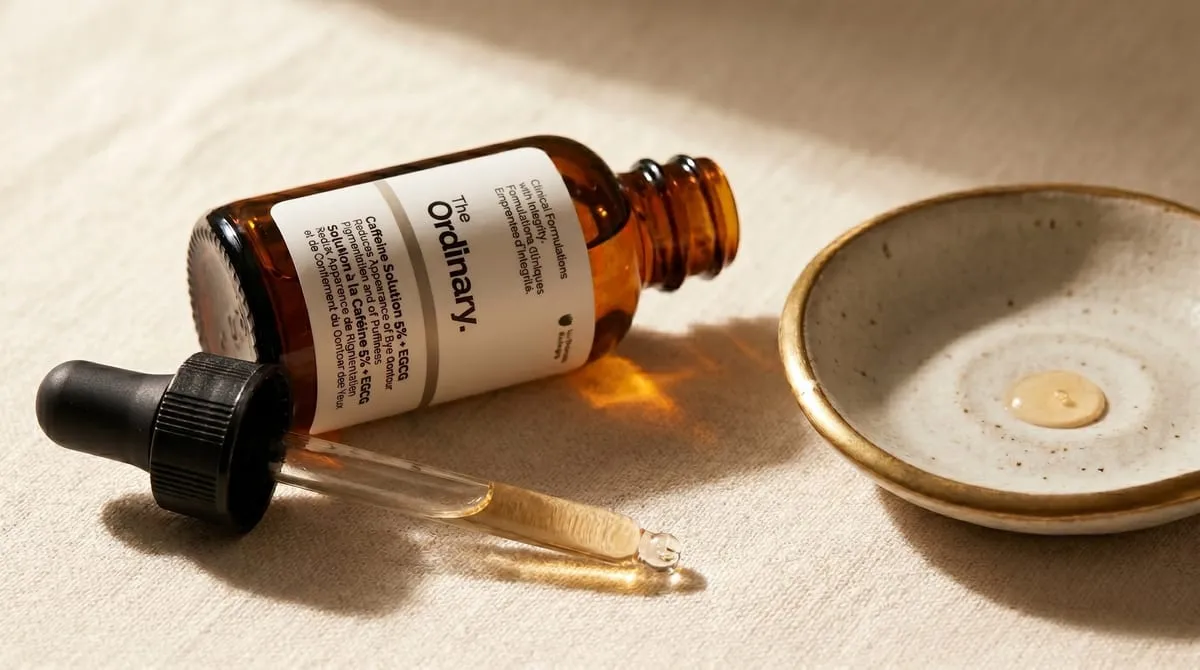
Three things buyers notice on day one: the texture, the dropper, and the smell.
The texture is the color of weak iced tea — that warm amber tint comes from the EGCG molecule itself. The consistency is watery with a slight viscosity, one of the lightest formulas in the entire Ordinary line. One dropper-full goes a long way. The most-repeated phrase in the reviews is some version of “absorbs in seconds, no residue.”
The dropper is the second tell. The Ordinary’s signature minimal-pharmacy aesthetic: 30ml glass, square cap, two-tone gray paper label printed flat. No marketing copy, no glossy plastic, no rose-gold pump. The bottle is small, well-made, and obviously not built for travel — the glass dropper will not survive a checked bag without bubble wrap.
The smell — or really, the absence of one. The serum is fragrance-free in the strict sense. There’s a faint botanical note that’s the EGCG and caffeine themselves, gone in 30 seconds. No perfume, no essential oils, no synthetic scent. That alone separates it from 80% of the $40 department-store serums it’s quietly outperforming.
Use #1: As The Morning Depuff
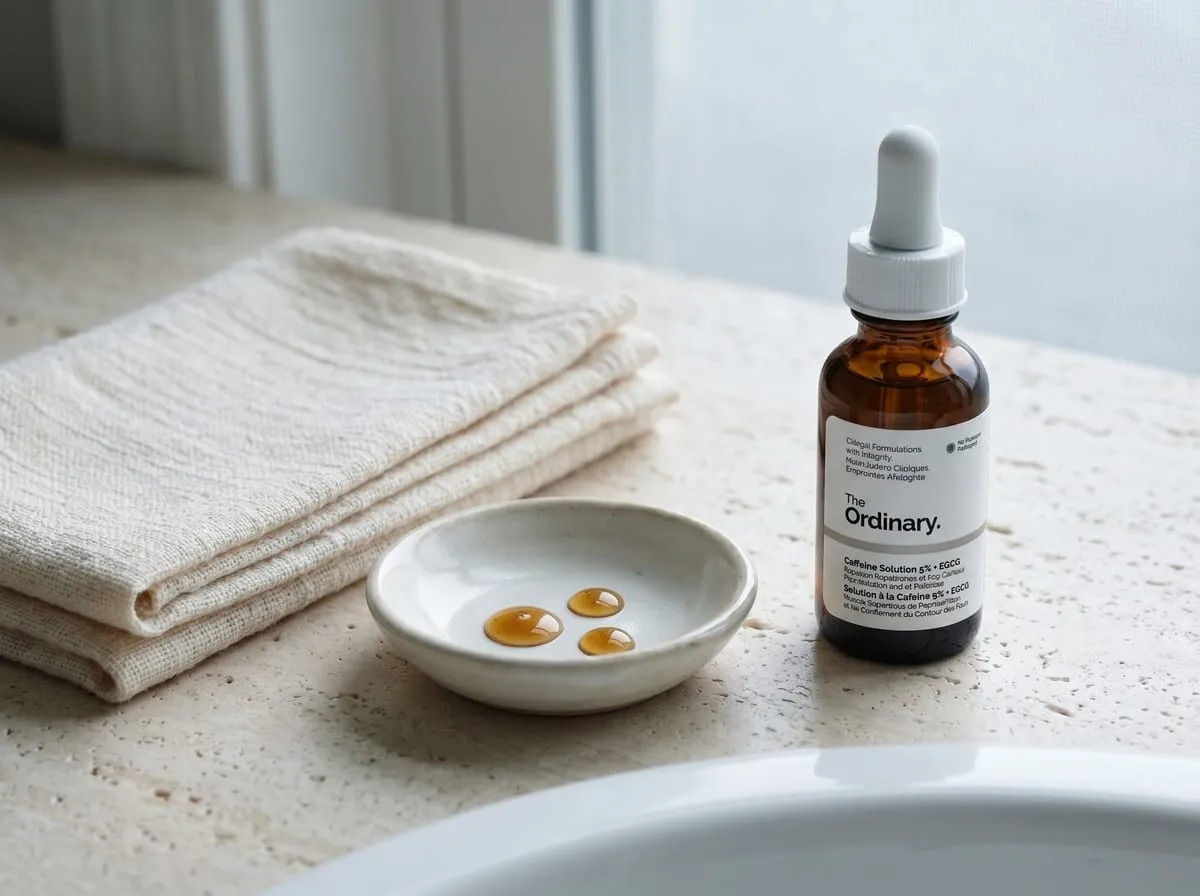
This is what the product was built for.
Caffeine is a vasoconstrictor — it temporarily narrows the small blood vessels just beneath the skin’s surface. Under-eye puffiness in the morning is partly fluid pooled overnight in the soft tissue beneath the eye. Constrict the vessels, the fluid moves out faster, the surface flattens. The effect is short-acting (a few hours) and surface-level, but for the AM under-eye it’s real and visible on day one.
The routine that comes up in the reviews: cleanse, pat dry, place two to three drops on the back of the non-dominant hand, press with the ring finger, pat into the orbital bone and outer corner. Wait 60-90 seconds for full absorption before moisturizer. Two-minute pause before concealer to avoid pilling.
The most-repeated word in the enthusiastic reviews is “immediately.” One buyer with allergy-driven morning puffiness describes pairing it with their eye drops and seeing and feeling improvement right away. Another, whose puffiness stems from an autoimmune condition, describes it working in seconds and rating it above the rest of the line.
This is the immediate caffeine effect. No four-week wait, no purging window, no learning curve. Apply, wait, see.
Use #2: As The Slow-Compound Antioxidant
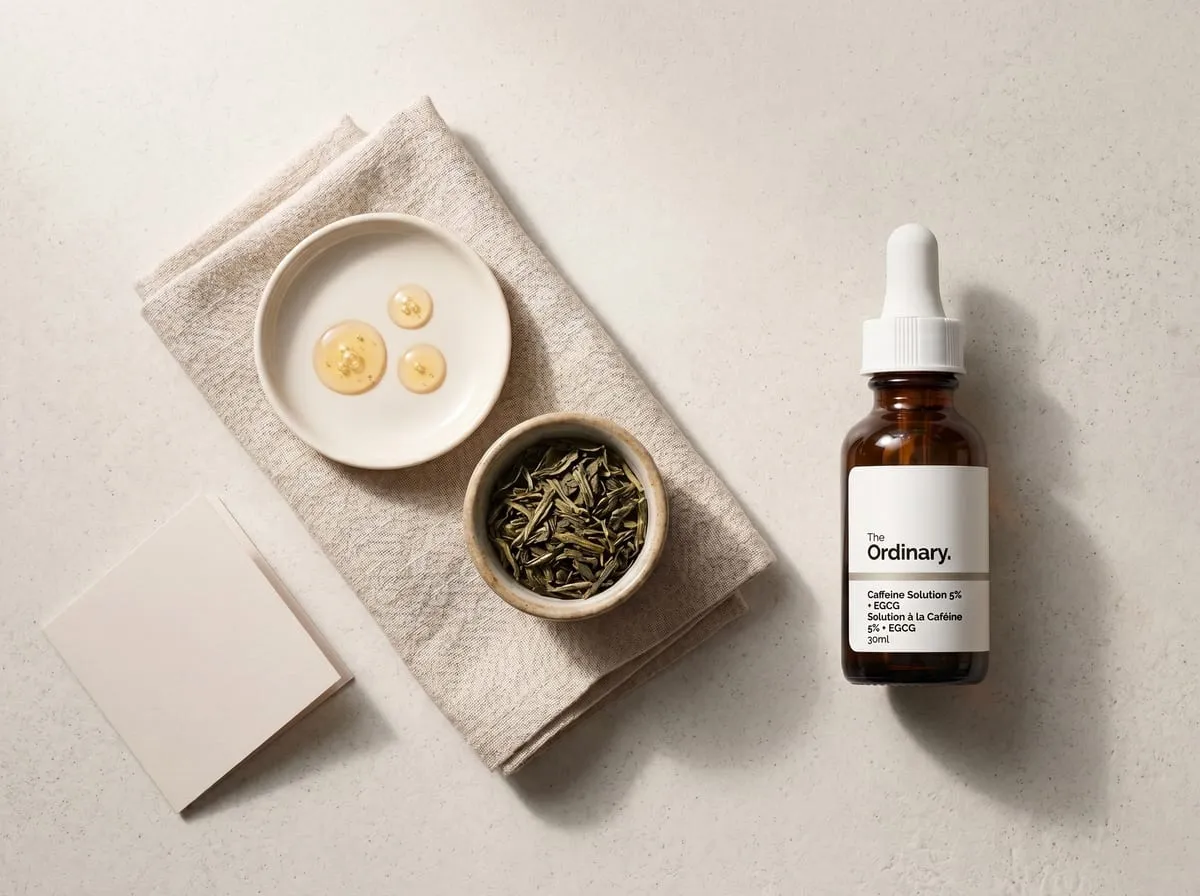
The second use is the one the marketing under-sells.
EGCG — epigallocatechin gallatyl glucoside — is a green-tea polyphenol that does two related jobs in skincare. It’s a potent antioxidant that neutralizes UV- and pollution-driven free radicals before they oxidize pigment in the skin. And it’s anti-inflammatory in its own right, dampening the chronic low-grade inflammation that puffiness sits inside.
This is a slow-compound effect, not a same-morning result. Reviewers who use the bottle daily for a month or more describe a different pattern than day-one users. One buyer juggling extra jobs on top of a 9-to-5 — and the sleep deficit that comes with it — reports that after a little over a month the dark circles have visibly minimized.
A significant fraction of what reads visually as “dark circles” is not pigment at all — it’s the bluish shadow of capillary blood vessels showing through thin under-eye skin. Constricting those vessels narrows the shadow and the under-eye reads lighter. Stacking EGCG on top slows the pigment-driven dark circles that build over years from UV and pollution exposure. Two timelines, one $10 bottle.
Use #3: As The First Active
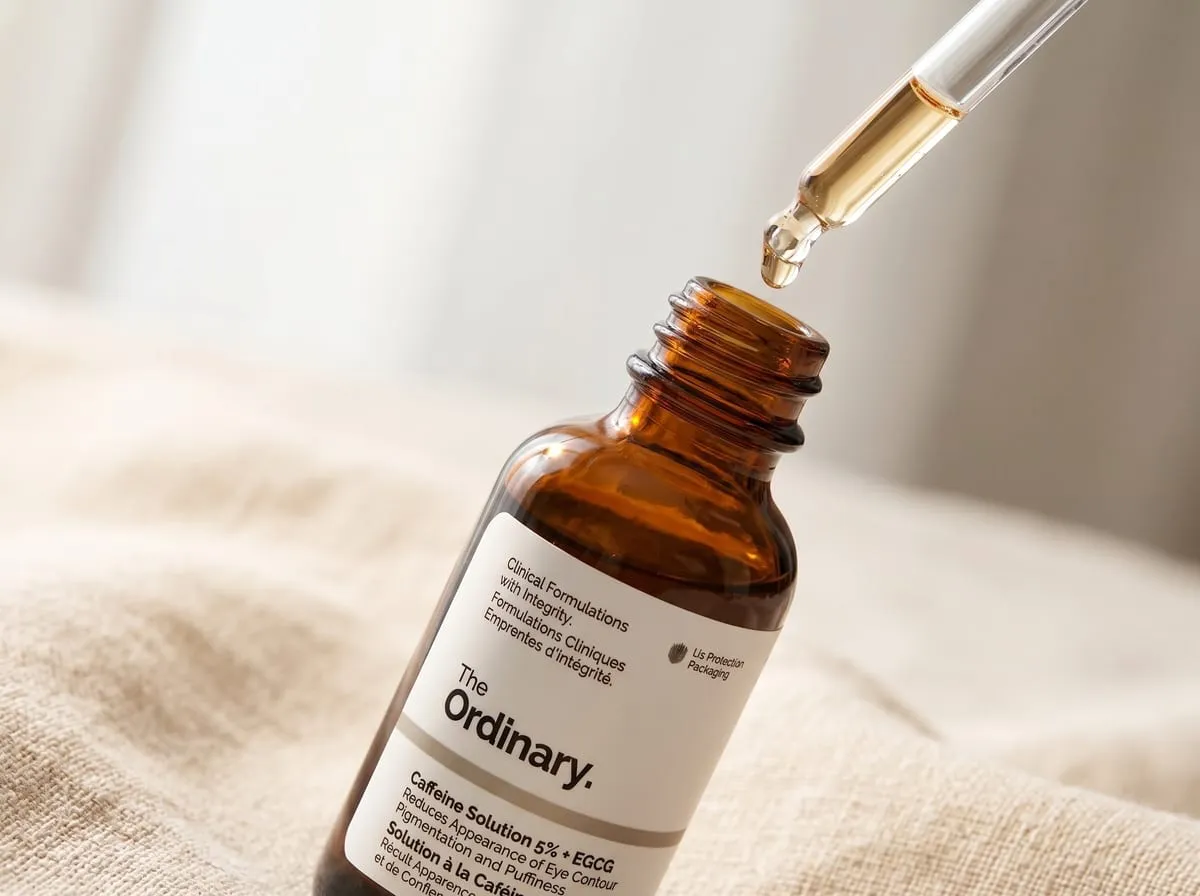
The third use is the one that explains the 8-year staying power.
A specific kind of reader keeps showing up in the reviews: someone who has never used an active ingredient before, is hesitant about $40-$100 actives at the department store, and wants to know what the difference between “moisturizer with caffeine” and “5% caffeine serum” actually feels like before committing.
For that reader, this is the entry point. Under $10 to find out. 30 days to a verdict. No purging, no photosensitivity, no learning curve, no SPF demand the user wouldn’t already have. Two drops on the orbital bone, wait, moisturizer, SPF. That’s the whole routine.
A specific upgrade path opens once the habit is built: this bottle stays as the AM step (caffeine handles morning fluid + vasoconstriction), and a retinal eye serum like Beauty of Joseon Revive gets added in the PM (retinal handles cellular remodelling). Different jobs, different times of day, together they cover what neither does alone. Total spend: still under $35 for a stack that competes with $200 of department-store skincare.
Buyers keep landing on the same verdict: it works well and fast, and at the price there’s little to complain about.
The Solution Test: Why The Ordinary Names It That
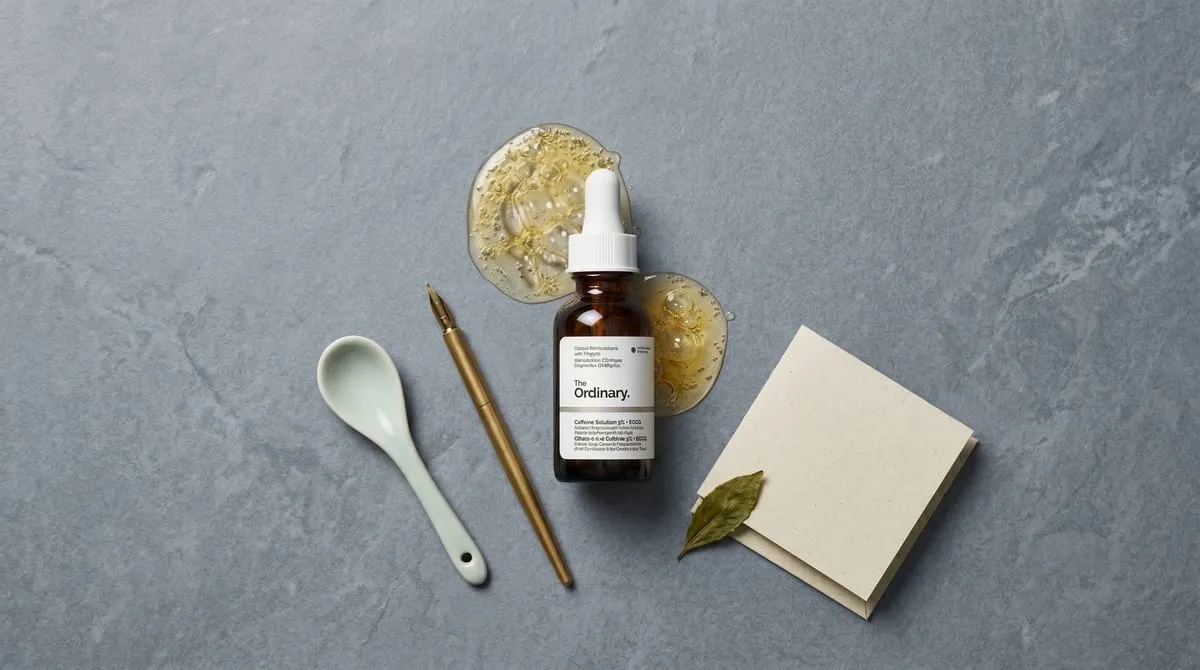
The name is the spec. “Caffeine Solution 5% + EGCG” is what’s in the bottle: caffeine at 5%, EGCG at a meaningful concentration, in a water-soluble solution. No proprietary blend names, no patented complex, no “with skin-loving botanicals.” Just the ingredient and the percentage.
This is Deciem’s whole thesis. The Canadian parent company launched in 2013 calling itself “the abnormal beauty company” and built The Ordinary as a line where the product name IS the ingredient. The branding is the absence of branding. The price reflects what the formula actually costs to produce plus a small margin — under $10 for 30ml is not a sale price, it’s the price.
For the under-eye specifically, two things matter about the format. First, the formula is water-based, which means it sits early in the routine (before any oil, balm, or moisturizer). Second, the dropper bottle is glass and opaque enough that direct counter light is fine, but the bathroom window-sill is not — caffeine and EGCG both degrade in heat and UV.
The 5% concentration is the upper end of the cosmetically useful range. Above that, the formula gets harder to keep stable and the marginal benefit shrinks. The Ordinary settled at 5% deliberately — it’s the dose that actually does work in a fragrance-free, water-soluble system that’s safe for daily use.
What’s Actually In It
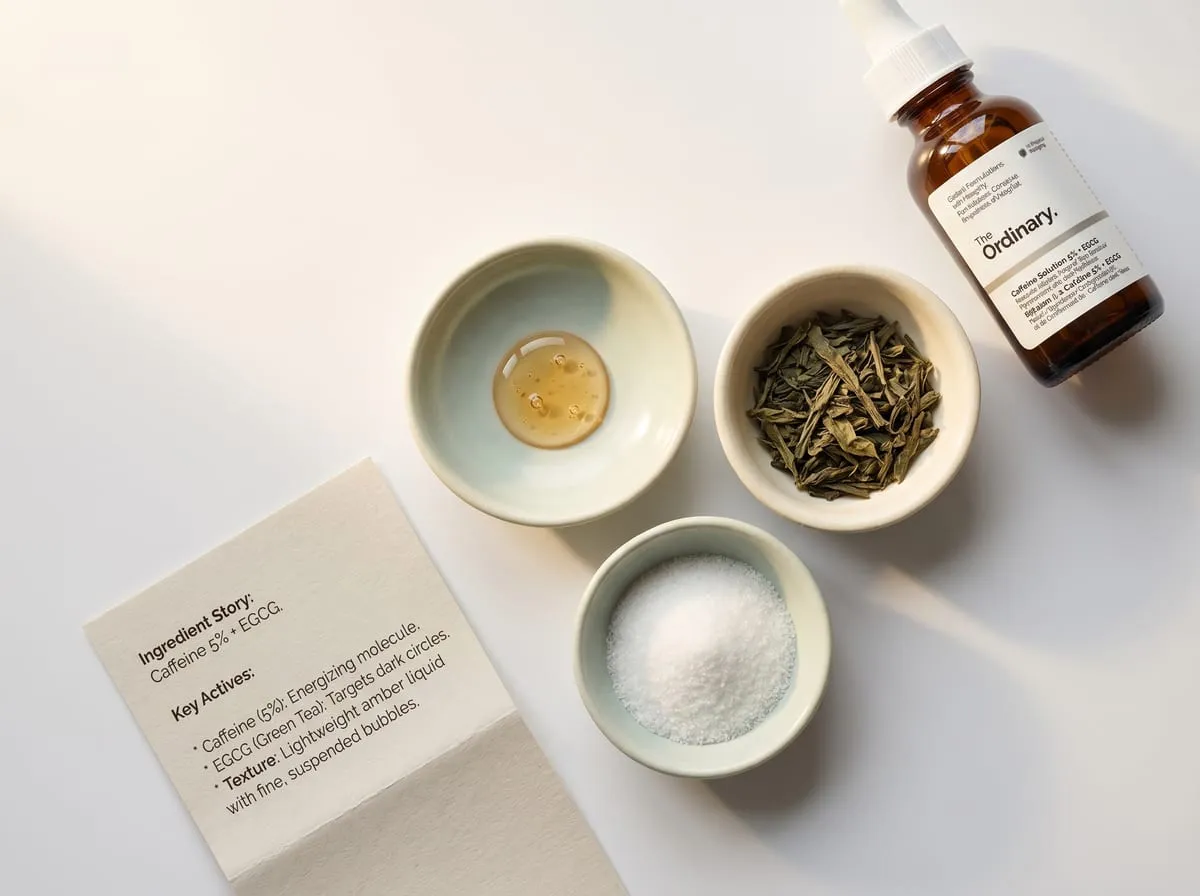
Two actives do all the work. The rest is what’s missing.
- Caffeine at 5% — the headline active. Vasoconstrictor that narrows the small blood vessels under the eye, reducing fluid pooling (puffiness) and the bluish shadow of capillaries showing through thin skin (the perception of dark circles). Effect starts on first contact and compounds with daily use.
- EGCG (Epigallocatechin Gallatyl Glucoside) — a stable green-tea polyphenol derivative. Antioxidant that neutralizes UV- and pollution-driven free radicals before they oxidize pigment. Anti-inflammatory. The slow-compound pillar that handles the years-long pigmentation defense the caffeine alone can’t.
- Water + propylene glycol base — keeps the formula thin enough to layer under sunscreen and concealer without pilling. The opposite of the heavy, oil-loaded “eye cream” texture that most $40+ jars ship in.
What’s missing matters: no synthetic fragrance, no essential oils, no drying alcohols, no parabens. Vegan, cruelty-free. The brand publishes the full INCI list publicly — no hidden actives, no patented blends, no marketing-name substitutes.
The functional argument: caffeine handles the acute morning depuff, EGCG handles the chronic compounding pigment defense, water-base lets both layer cleanly under SPF and concealer. One $10 bottle. Two timelines.
What the formula does not do: it doesn’t refill structural tear-trough hollows (a dermatologist conversation, not a serum), it doesn’t bleach genuinely deep dermal pigment, and it doesn’t replace daily SPF (the single biggest preventer of pigmentation that exists). Manage expectations on those three.
Is It Worth $10?
Short answer: it’s the easiest yes in skincare.
- Department-store caffeine serums: $40-$80 for 15-20ml. Same molecule, weaker concentration, fragrance added, packaging premium.
- Drugstore “eye creams with caffeine”: rarely above 0.5% caffeine, hidden inside 50ml of moisturizer. Active dose per application is a fraction of what The Ordinary delivers in two drops.
- Cooling rollers and metal eye balls without active ingredients: pleasant for two minutes, zero compounding benefit.
- The Ordinary Caffeine 5% + EGCG: under $10 for 30ml. 5% caffeine. EGCG. Water-light vehicle that layers cleanly under SPF and concealer.
Two to three months per bottle at daily use. That’s roughly $0.10 a day for a serum that competes with $50 actives on real clinical mechanism. The math isn’t close.
How we scored the The Ordinary Caffeine Solution — 4.4 / 5
My rating isn’t an average of anyone’s stars — it’s an editor’s read across the things that actually decide whether an under-eye serum earns its spot — weighed from the feature set, the published specs, the formula, and the themes that recur across owner feedback. Here’s how the The Ordinary Caffeine Solution landed:
| What we weighed | Call | Why |
|---|---|---|
| What it does | Strong | Caffeine vasoconstriction depuffs the morning under-eye on day one, and EGCG slow-compounds pigment and dark-circle defense over a month of daily use. |
| Formula & ingredients | Excellent | 5% caffeine sits at the upper end of the cosmetically useful range with a meaningful EGCG dose, fragrance-free and free of essential oils, drying alcohols, and parabens. |
| Texture & feel | Strong | One of the lightest serums in the line — watery, absorbs in seconds with no residue, layers cleanly under SPF and concealer when paced right. |
| Value | Excellent | Under $10 for 30ml lasts two to three months, roughly $0.10 a day against $40-$80 department-store serums with weaker doses. |
| Who it suits | Good | An ideal first active and AM partner to a PM retinal, though caffeine-sensitive skin and structural tear-trough hollows are outside what it can address. |
Why 4.4 and not a perfect 5: the effect is real but bounded — it won’t refill structural tear-trough hollows, bleach deep dermal pigment, or replace daily SPF, and the glass dropper needs bubble-wrap to survive checked luggage. Honest limits on an otherwise easy win.
This is my own editorial rating — not an average of Amazon’s stars. How I rate →
The Verdict
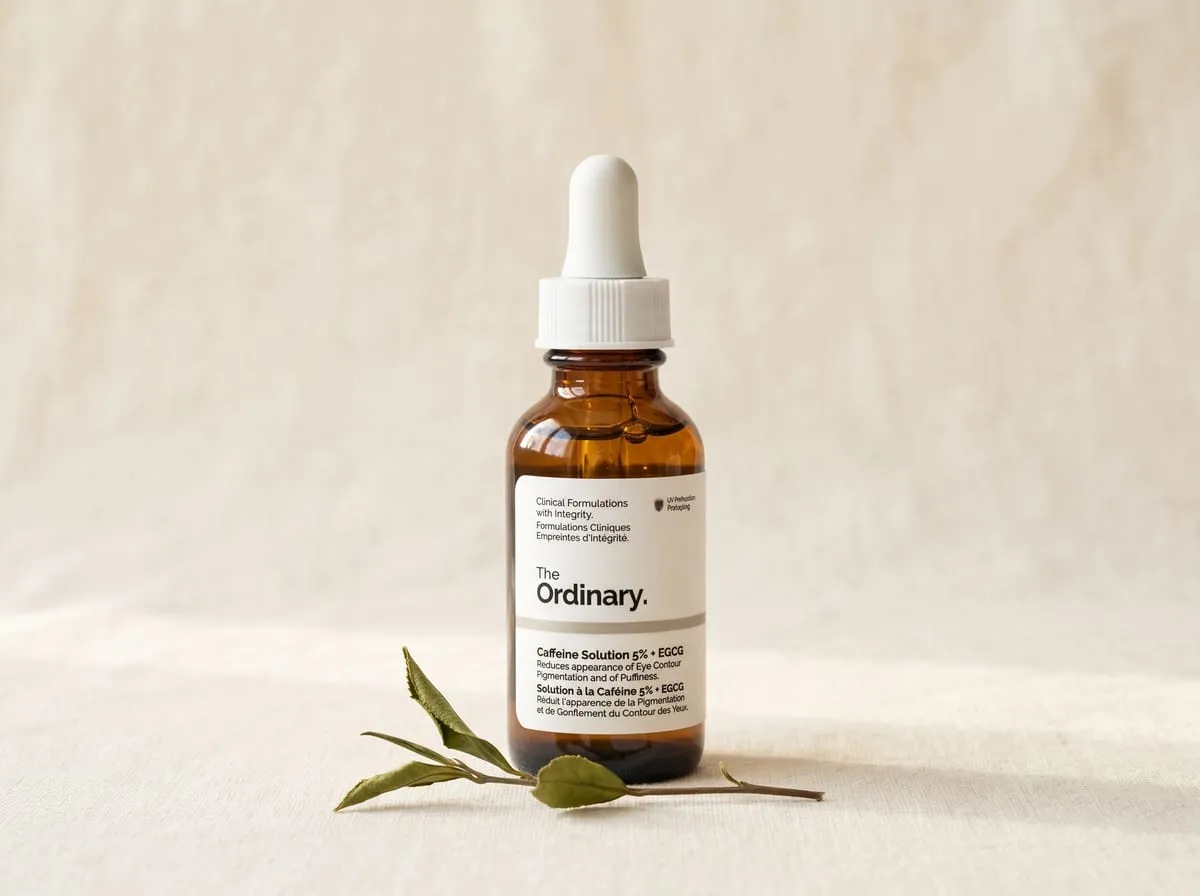
After working through tens of thousands of verified reviews, eight years of shelf staying power, and a formulation lineage that names itself after its ingredients, here’s the read: The Ordinary Caffeine 5% + EGCG is the rare cult product that earned its reputation in clinical mechanism, not marketing. Caffeine to depuff. EGCG to defend pigment. Water-light vehicle. Under $10 for 30ml.
Buy it if you:
- Want a real active for the under-eye at the lowest possible cost of entry
- Wake up with puffy or fluid-pooled eyes (allergies, short sleep, autoimmune flare)
- Have never used a skincare active and want to start cheap
- Already use a PM retinal and need the AM caffeine partner
- Prefer fragrance-free, vegan, cruelty-free skincare
Skip (or pair differently) if you:
- Have structural tear-trough hollows (that’s a dermatologist conversation, not a serum)
- Use heavy oil-based concealer immediately after serum (pilling — fix the routine pacing instead)
- Have caffeine-sensitive skin (patch test on inner forearm first)
- Travel with checked luggage and don’t want to bubble-wrap a glass dropper
FAQ
Q: How quickly does the Caffeine Solution work? The caffeine vasoconstriction effect shows on first contact — many buyers describe “immediate” depuffing on the AM application. The EGCG antioxidant defense is a slow-compound effect that shows up at four to eight weeks of daily use.
Q: Can it be used under makeup? Yes — that’s the most common use case. Wait 60-90 seconds after the serum sinks in, then moisturizer, then a two-minute pause before SPF or concealer. Pilling complaints almost always trace back to skipping that pacing.
Q: How does it compare to retinal eye serums? Different jobs. Caffeine handles AM fluid + surface depuffing. Retinal handles PM cellular remodelling. Common pairing: this in the morning, a retinal eye serum like Beauty of Joseon Revive at night.
Q: How long does one bottle last? Two to three months at daily AM use. Slightly less if used twice daily AM + PM.
Q: Can I use it if I have sensitive skin? A small minority of users with caffeine-sensitive skin can react — patch test on the inner forearm first, wait 24 hours. The formula itself is fragrance-free, vegan, and free of common irritants (essential oils, drying alcohols, parabens).
Q: Where can I buy The Ordinary Caffeine 5% + EGCG? Available on Amazon here — usually faster shipping than the brand site.
Q: Is it vegan and cruelty-free? Yes — vegan, cruelty-free, fragrance-free per Deciem.
Part of our Tired-Eye Rescue Top 5 roundup — the full lineup of patches, serums, and one editor splurge for under $55.
Join the Nova’s Picks community 🔍
Get new honest reviews, roundups & finds first — and ask me what to buy before you do.
Join the free Facebook group →